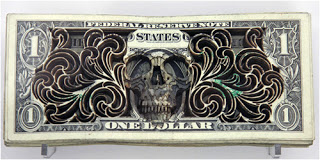
Is an MFA in Visual Arts worth the price tag?

September 5, 2011 12 Comments

Images by Scott Campbell

Is an MFA in Visual Arts worth the price tag? In today’s economy, how do we justify spending $60,000 on a degree which may or may not pay off?

I am not making a statement. I am asking a question. I know too many MFA graduates who owe more money in graduate loans than they can hope to ever earn as adjunct professors and professional artists. Personally, I know many, many artists who owe from $20,000 to $80,000 for their graduate education – I know this is not unusual. For those MFA’s who find themselves full-time professorships, Fullbright Grants, and MacArthur Fellowships, I say it was money well spent/owed. For the rest of us, I’m not so sure.

As I write this, more colleges than ever before are rushing to add MFA in Visual Art Programs. This means that every year, more MFA degrees are granted, flooding an already small market. It’s not surprising. Colleges consistently earn more income from graduate studies than undergraduate ones, which are heavily subsidized and scholarshipped. MFA programs are a money maker and colleges need money.

Here in Baltimore, MICA seems to add a new MFA program or two each year. This year the new MFA in Curatorial Studies Program enters its inaugural year, and it looks like an amazing program. All the grad programs at MICA are consistently filled with students, so there is definitely a ‘need’ for them. While we should celebrate the vast array intellectual opportunities that are now available, it seems irresponsible to do so blindly. For every prospect, there is a price tag. How can we justify the cost of a degree which doesn’t offer any direct employment options? Why do artists willingly sign themselves into debt and servitude for a professional field which, on the whole, does not pay its practitioners?

If you are currently in the process of applying for an MFA degree, or presently enrolled in an MFA program, I would like to hear from you. How are you financing your education? What are the strategies that can make the whole experience more affordable and valuable?

Let’s be honest: most artists do not crave riches, but what we do need, above all else, is TIME to make our work. How can we expect to grow forward if we’re saddled with a huge dept? How can an artist guarantee enough time for the studio if she is constantly working to pay back her debt?

Above all else, artists are creative. How can a young artist be creative about their financial future and also complete an MFA?

Image by Scott Campbell

Uncategorized

12 Comments → “Is an MFA in Visual Arts worth the price tag?”

  1. shana goetsch 1 year ago  

    I am currently in an MFA program at MICA – Community Arts. I would say it’s been money and time well spent. I wasted way more money on an undergrad painting degree. But I looked for a masters program that would give me real world experience, a liberatory education, many real world skills for artist/professionals (and money back, in essence, for school, through an AmeriCorps education/service award – AmeriCorps is part of the program’s first year) That being said, I do wonder about people who get an MFA in studio…I applied for this degree to be able to get a job in the arts, solely, because I couldn’t get one with a BFA in studio. so…?

  2. Micah Cash 1 year ago  

    Your question is a difficult one, and one that I’ve been struggling with for three years now. In order to justify such an expense we first need to ask, WHY do we need an MFA?

    As difficult as it is to succeed with one’s art, it is even more difficult to do so without an MFA. You can’t teach a credit-bearing course. Dealers and galleries usually view you as “untrained.” And if/when an artist has to get a day job to make ends meet, the pay will be less than others. In many cases, if one wants to be taken seriously as an artist, he or she must get an MFA. It is practically forced upon us.

    Unless you’re one of the lucky few you mention to be chosen for a grant, fellowship, or professorship, it seems like a worthless and expensive degree. I believe, however, that a serious artist has more opportunity with one than without one.

    After extensive research into graduate programs over the years, I’ve come to believe that it is better to apply and attend programs that offer significant financial assistance. Forget rankings. Find a school that fits you. A school that views the time spent for an MFA as time for research and focus and is willing to back that up with tuition waivers and fellowships/assistantships.

    The difficulty, of course, is getting accepted into a program. Any program. Even the “assembly line” graduate schools are competitive and fickle toward what type of art and students they’re looking for.

  3. Anonymous 1 year ago  

    I honestly believe a MFA degree is useless, unless you want to teach @ college level adjunct. Art galleries care more about the quality of your work, and how many shows you’ve done and where. If you dont’ want to teach and all you care about it being a professional artist, it is better to save the $$, buy yourself some time, and spend your effort making good work and showing it. I have never had a gallery not show my work b/c i don’t have a MFA.

  4. Anonymous 1 year ago  

    I read on MICA’s website they just got 10 MILLION DOLLARS from the Bunting Family for graduate studies.

    Quote: The largest gift in the College’s history will help provide the human, infrastructure, technological and artmaking resources the College will need to support its graduate studies program.

    What does that mean? They COULD allow all their grads to attend for free or for not much, but I am guessing they’ll spend it all on another damn building.

  5. Anonymous 1 year ago  

    In 2009, I completed my MFA in Painting – 2 years later, I am beginning to feel some of the frustrations that sent me to grad school in the first place…
    I chose to go to graduate school to further my own understanding of my work, the art world, my peers and how to make it as an artist.

    Currently, I am working in a non-art-related part time job (for $9/hour), an adjunct position (that pays $1,300 less than the first adjunct position I had while I was still in graduate school), and an un-paid internship at a gallery. Then why go to grad school, acquire more debt and have fewer professional options than before completing my degree…? Because I valued the community of peers I would develop in a graduate program and my understanding of art, the art world, and careers changed forever. I can’t believe the debt I’m still in (even though the tuition was covered by the grad program) but I think it’s worth it! My best advice, similar to that of others, is to find a program that wants you enough to pay your tuition in full! It will make a world of difference!

  6. Anonymous 1 year ago  

    it costs thousands of dollars a year to make art whether you are in school or not. Being in a program can alow you access to the time and money you need to make the work that you want to make for two or three years and thats MotherF***ingAwesome. Get alot of satisfaction out of what your doing, or dont do it, because the ‘sucess’ probably wont come. An MFA is an indulgent thing to do and youll be in debt forever but who really cares about their college loans?

  7. Mark 1 year ago  

    “I am guessing they’ll spend it all on another damn building.”
    Ha, good guess.

  8. anonymous 1 year ago  

    A MFA is useful in the long run only if you plan to teach art on the college level. In today’s world, unless the program actually teaches you how to market and sell your work, an artist may be better off with a business degree and a good understanding of finances. Paying back the loans starts a debt cycle that is often unbelievably hard to get out – just life’s expenses are a challenge to keep up with much less a student loan. I agree with anonymous – art galleries don’t really care if you have a MFA – just if your work sells and makes them a profit. It is better to gain skills that will further your employability and savor every free moment of time you have to create your artwork. More debt usually means more time spent at work and less time or energy to be creative.

  9. Anonymous 1 year ago  

    i moved to baltimore 8 years ago to go to MICA. I started putting together a portfolio and then i looked at the price. i couldn’t afford it, and rather than being saddled by absurd amounts of debt for the rest of my life. i just gave up on the prospect of a degree in art. Instead i got a job working 3 days a week and the other four i spend painting…im not sure if its been the right choice, but i have had shows and i have sold work. becoming successful at anything is a long road that is most certainly non-linear.

  10. sobohon 1 year ago  

    MFA in curating? Honestly? Sheesh. I’ve been curating for years and have never received a dime from it. I did get a few lunches. Good return on $60k? Hardly.

    I’ll never regret the four years of getting the BFA in painting at MICA, but the tuition wasn’t as insane as it is now. Plus, I had help with scholarships & grants. I don’t know how kids do it now. Sure, I’d love to pursue an MFA, just to have 2 years to concentrate on painting only, but for the bucks, I can’t justify the degree. If I wanted to teach at college level, maybe, but I’d rather paint.

    It’s the work that matters ultimately. I’d rather put my money into time, studio space, materials & experience.

  11. Anonymous 1 year ago  

    I am coming really late to this post but I feel moved to comment anyway – I applied to MICA in 2006 and I was accepted for a BFA admissions… I had a meeting with the financial aid advisor and she told me not to do it – that’d I would be in debt for the rest of my life. It pissed me off at the time, I wanted to find out how to get money, not whether I should… Suffice it to say I didn’t go to MICA and I thank God I didn’t – right now I am studying Anthropology at Towson and being paid to go to school while I make my art in my spare time and during the summers. I think the whole advanced degree system/expectation for ALL careers is fucked up… If you want to get an advanced degree in a job field that is actually growing go to the Bureau of Labor Statistics and check out the stats, Masters programs are BUSINESSES and offer degrees regardless of job opportunities… As for people with ANY college debt hopefully the Obama administration, if re-elected will introduce some loan-forgiveness legislation b/c how are young people supposed to start their lives in a financial hole? It is a national issue and one that people are finally starting to talk about, thank good-ness…

  12. Anonymous 10 months ago  

    I’m an MFA candidate in one of the grad programs at MICA. I’ve been supported for about 30% of my tuition with fellowships. With undergrad and grad debt, I’m looking at 50k of debt total. For a terminal degree from a decent program—I think it’s way too
    much, but I do t regret it.

    It’s a very personal decision.

    It’s not ideal, but Ive made concessions like driving a used car, not going out as much,etc. To pay my $255 a month student loan. I can’t imagine breaking into a real art career without at least an undergraduate degree in your discipline or some critical theory to arm you before trying to make a solid body of work. If your goal is to have a booth at a sidewalk art festival or make pretty crafts for family members—-than, by all means, learn another trade amd don’t pay for the degree. But, if you’d like to teach, further the dialogue of contemporary art and show work, I think it’s worth the investment.

    If I had to do it again, I’d go to a state program for free or go some place killer for grad school with big AID.

Follow

Get every new post on this blog delivered to your Inbox.

Join other followers: